
Did you know that one of the simplest and most effective ways to remember something is to take time to forget it and then work hard to remember it?
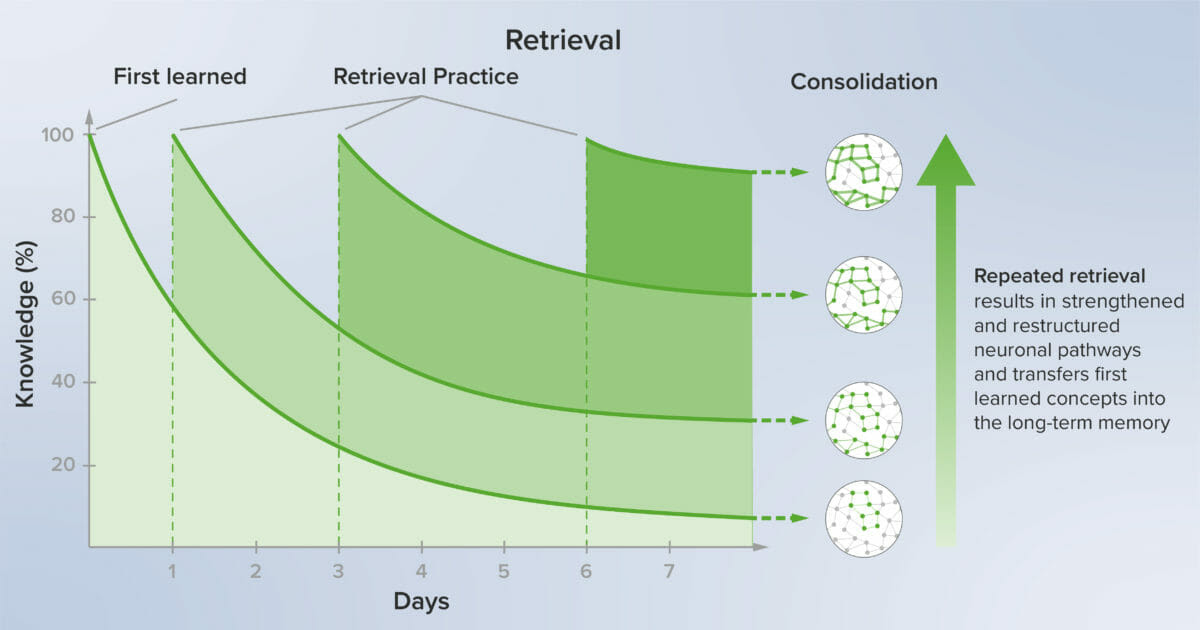
About 150 years ago, a German psychologist, Hermann Ebbinghaus, taught himself hundreds of nonsense words and tested himself at different intervals to determine the rate of forgetting. In addition to accurately plotting a curve that is still robust today, he also stumbled across a helpful learning strategy: the testing effect. The act of effortful retrieval strengthens the memory trace. The more frequently he tried to retrieve the nonsense words after a gap of time, the better he remembered them. Of course, you want your students to remember your course content and not nonsense words, but the same principle applies.
Check out this helpful illustration from Lecturio.
For more information about retrieval practice, including the research behind it and strategies for integrating this in various learning modalities, check out the retrieval practice website.