
Experiential Education offers several benefits for both faculty and students. For faculty, it provides an opportunity to engage with students in a more dynamic and interactive way, fostering a deeper connection and understanding of the subject matter. It allows faculty members to step away from traditional lecture-based teaching methods and instead facilitate hands-on experiences that encourage active learning and critical thinking. This can be empowering for faculty as they witness firsthand the impact of their teaching on students’ learning and growth.
Experiential Education also empowers students by making their learning experience more personal and relevant. When students are actively involved in their own learning process, they have a stronger sense of ownership and motivation. They can see the direct application of what they are learning, which enhances their engagement and enthusiasm for the subject matter.
Explore the Experiential Education Toolkit and Career Readiness Connections for more support on implementing this approach in your courses.
Experiential Education vs Experiential Learning
Experiential education (EE) is defined as the philosophical process that guides the development of structural and functional learning experiences. Experiential learning (EL) is defined as the specific techniques or mechanisms that an individual can implement to acquire or meet learning goals (Roberts, 2012).
Take the Experiential Education Course
Module 1: Introduction to Experiential Learning
Module 2: Kolb’s Learning Cycle, Praxis, and Educator Roles
Module 3: High Impact Practices, Design, and Assessment
Module 4: Getting Started with Experiential Learning at UMPI
Experiential Teaching & Learning
Experiential teaching and learning is an educational approach that emphasizes active engagement, a variety of hands-on experiences, and reflection as key components of the learning process. It moves beyond traditional sage-on-a-stage-based instruction and encourages students to participate in real-world activities, experiments, projects, or simulations that directly relate to the subject matter being taught.
In experiential teaching and learning, students are actively involved in their own learning process. They engage in firsthand experiences that allow them to apply theoretical knowledge, develop practical skills, and make connections between concepts and real-life situations. This approach promotes critical thinking, problem-solving, and decision-making skills as students encounter challenges and find solutions through active engagement.
Experiential teaching methods often involve collaborative and interactive activities that encourage students to work together, share ideas, and learn from one another. This fosters a sense of community and teamwork, enhancing social skills and communication abilities. Reflection is also an integral part of experiential teaching and learning. Students are encouraged to reflect on their experiences, analyze their observations, and make connections to the underlying theories or concepts. This reflection process helps deepen understanding, reinforce learning, and promote metacognitive skills by encouraging students to think about their own thinking.
Experiential education is a teaching philosophy that informs many methodologies in which educators purposefully engage with learners in direct experience and focused reflection in order to increase knowledge, develop skills, clarify values, and develop people’s capacity to contribute to their communities
aee.org
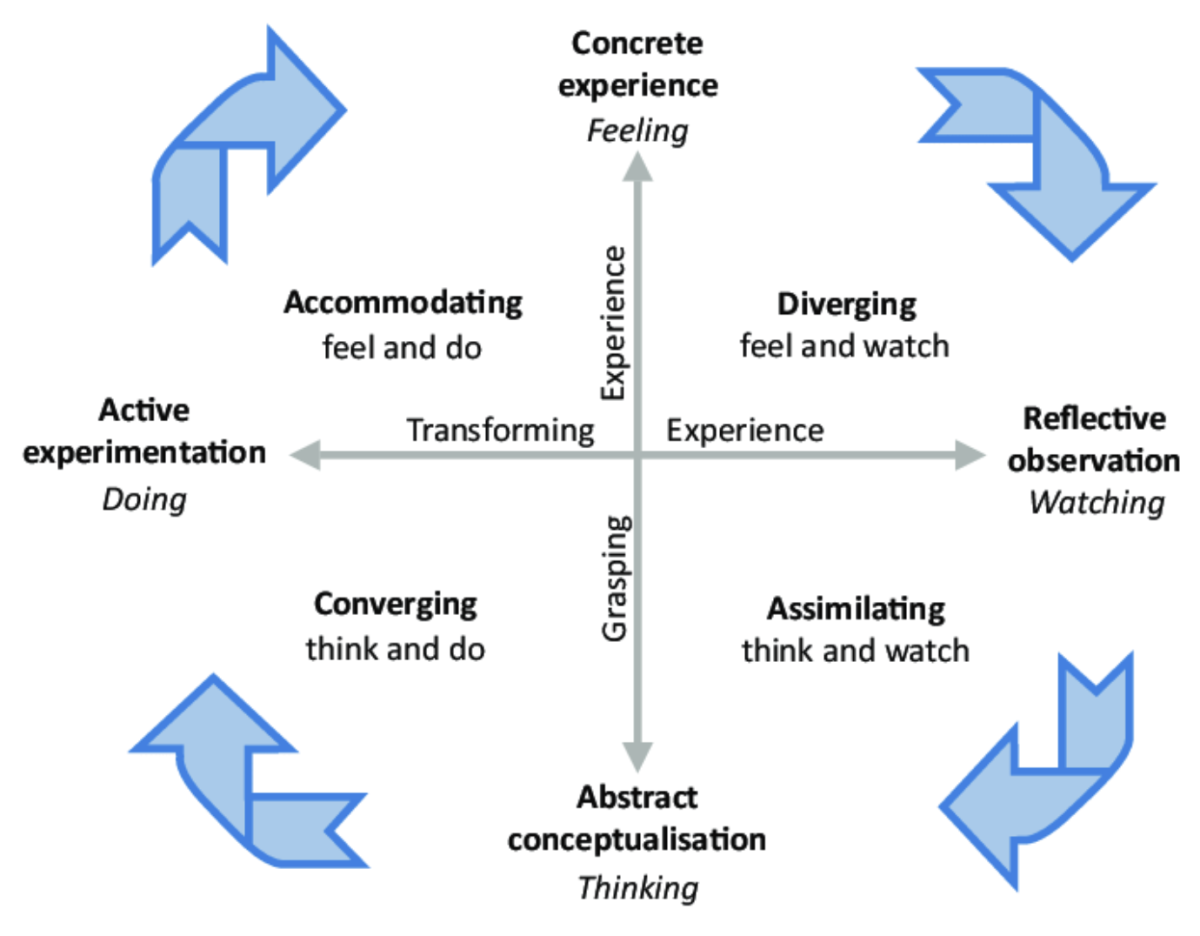
Applying Kolb’s learning cycle to classroom practice
Applying Kolb’s learning cycle to classroom instruction offers several benefits for both students and educators. Here are some of the key advantages:
- Enhanced Learning Engagement: Kolb’s learning cycle (which consists of four stages: concrete experience, reflective observation, abstract conceptualization, and active experimentation) promotes active engagement in the learning process. By incorporating activities that align with each stage, educators can increase student engagement and participation, leading to deeper understanding and retention of the material.
- Personalized Learning: The learning cycle recognizes that individuals have different learning preferences and styles. By incorporating a variety of activities that cater to diverse learning styles (e.g., hands-on experiences, discussions, visual aids), educators can create a more inclusive and personalized learning environment that meets the needs of all students.
- Critical Thinking: Kolb’s learning cycle emphasizes the importance of critical thinking through reflection. By encouraging students to reflect on their experiences, analyze their observations, and make connections to abstract concepts, educators can foster critical thinking skills and enhance students’ ability to analyze, evaluate, and apply knowledge in different contexts.
- Skill Development: Through the active experimentation stage of the learning cycle, students have the opportunity to apply their knowledge and skills in real or simulated situations. This promotes the development of practical skills, problem-solving abilities, and decision-making skills that are essential for success in various academic and professional settings.
- A Focus On Continuous Improvement: The iterative nature of Kolb’s learning cycle encourages continuous improvement. By reflecting on experiences and actively experimenting with new approaches, students can refine their understanding, skills, and strategies over time. This promotes lifelong learning and a growth mindset.