
Designing Authentic Assessments Aligned to Course Learning Outcomes
Authentic assessment focuses on engaging students in meaningful tasks that mirror the ways knowledge and skills are applied in real-world contexts. When designing assessments, the goal is to ensure that every task clearly aligns with your course learning outcomes (CLOs) and reflects the specific instructional modality—whether in-person, online, or hybrid.
1. Start with Clear Alignment
Begin by examining the CLO, PLO, and/or GLO to determine what authentic evidence would demonstrate achievement of those outcomes. For example:
- If a learning outcome emphasizes critical thinking, design assessments that require analysis, synthesis, or evaluation rather than recall.
- If an outcome focuses on collaboration or communication, integrate projects that require group problem-solving, peer feedback, or public presentations.
Each assessment should directly measure one or more CLOs, and rubrics should explicitly describe performance levels connected to those outcomes.
2. Match the Assessment to the Modality
Instructional modality influences how students engage with course materials and demonstrate their learning.
- Face-to-Face Courses: Leverage in-class demonstrations, live discussions, or studio critiques where observation and dialogue enrich feedback.
- Online Asynchronous Courses: Use digital tools—such as e-portfolios, multimedia projects, or discussion-based reflections—that allow flexibility in time and format.
- Hybrid or HyFlex Courses: Blend synchronous and asynchronous activities, ensuring equitable opportunities for assessment regardless of participation mode.
Consider accessibility and equity across modalities: students should have comparable opportunities to demonstrate their learning, even if the mode of interaction differs.
3. Emphasize Real-World Relevance
Authentic assessments often involve problem-based tasks, case studies, simulations, or projects that connect theory to practice. Ask: “Would this task make sense outside of the classroom?” When assessments mirror authentic professional or disciplinary practices, students develop transferable skills and deeper engagement with the subject matter.
4. Provide Transparency and Support
Communicate the connection between assessments and learning outcomes to students. Explain why a task matters, how it will be evaluated, and what success looks like. Scaffold complex tasks into smaller, manageable stages that include formative feedback opportunities. Make success criteria explicit with rubrics.
5. Reflect and Revise
Finally, regularly evaluate how well your assessments capture the intended learning outcomes across modalities. Gather student feedback, analyze performance data, and adjust assignments and rubrics to improve clarity, alignment, and authenticity over time.
Getting familiar with assessment types
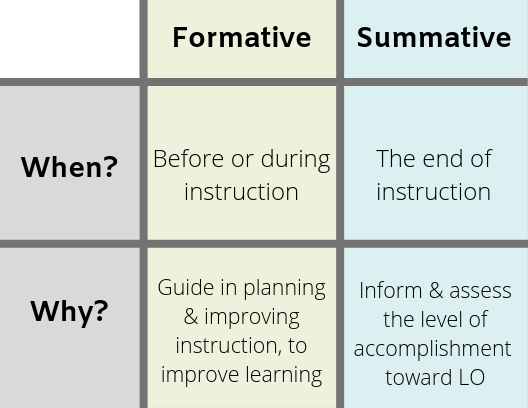
Assessment for Learning (Formative Assessment):
In this type of assessment, the focus is on providing specific, actionable feedback to the student so that he/she can make improvements.
This type of assessment may come in the form of:
- checking for understanding (thumbs up/down or exit tickets
- instructor observations
- feedback from low-stakes practice activities
Assessment of Learning (Summative Assessment):
In this type of assessment, the focus is on measuring student progress and achievement. Feedback is provided on how well the student performed on a particular skill or set of skills. This type of assessment is often used for grading purposes.
Examples of this type of assessment are:
- Unit or concept performative assessment, term paper or project
- Quiz or exam
Using Formative Assessment to Make Data-Informed Decisions
Creating ongoing, low-stakes formative assessment activities not only allows students to know how they are doing, but it allows you to collect and use data on what students know and can do at benchmark points throughout the course–so that you can adjust teaching and compare knowledge and skills attainment across course sections.
Alternative Online Assessments
There are many possibilities for alternate students assessment online such as presentations, student-created videos, and online discussions.