
YourPace at UMPI: A Practical Guide to Competency Based Education (CBE)
YourPace is UMPI’s competency-based education (CBE) modality designed for adult, working, and nontraditional learners. Instead of measuring progress by seat time or fixed semesters, learners advance when they demonstrate competency in clearly defined outcomes. This page orients you to how CBE differs from traditional models, what the learner experience looks like in YourPace, what faculty do differently, and how to get started building or refining a YourPace course.
Key Feature of CBE
Compare Modalities
- Standard calendar (e.g., 15-week term)
- Fixed pacing for everyone
- Peer learning opportunities
- Grades reflect aggregated points across varied tasks
- “Coverage” model can emphasize content exposure over verified mastery
- Structure centers on program/degree competencies → course competencies → module level skills
- Students start, pause, and advance based on readiness and evidence of mastery
- Assessments map 1:1 to stated competencies; feedback is targeted to close specific gaps
- Transparency: learners always know the competency, criteria, and what “meets mastery” means (supported by regional accreditors’ guidance) New England Commission of Higher Education
Why does this matter? Adult learners bring prior learning, busy schedules, and urgent career goals. CBE recognizes prior knowledge, reduces time to degree when mastery is demonstrated quickly, and keeps expectations constant while flexing the pacing.
The Learner Experience in YourPace

LEAN: The YourPace Course Design Approach
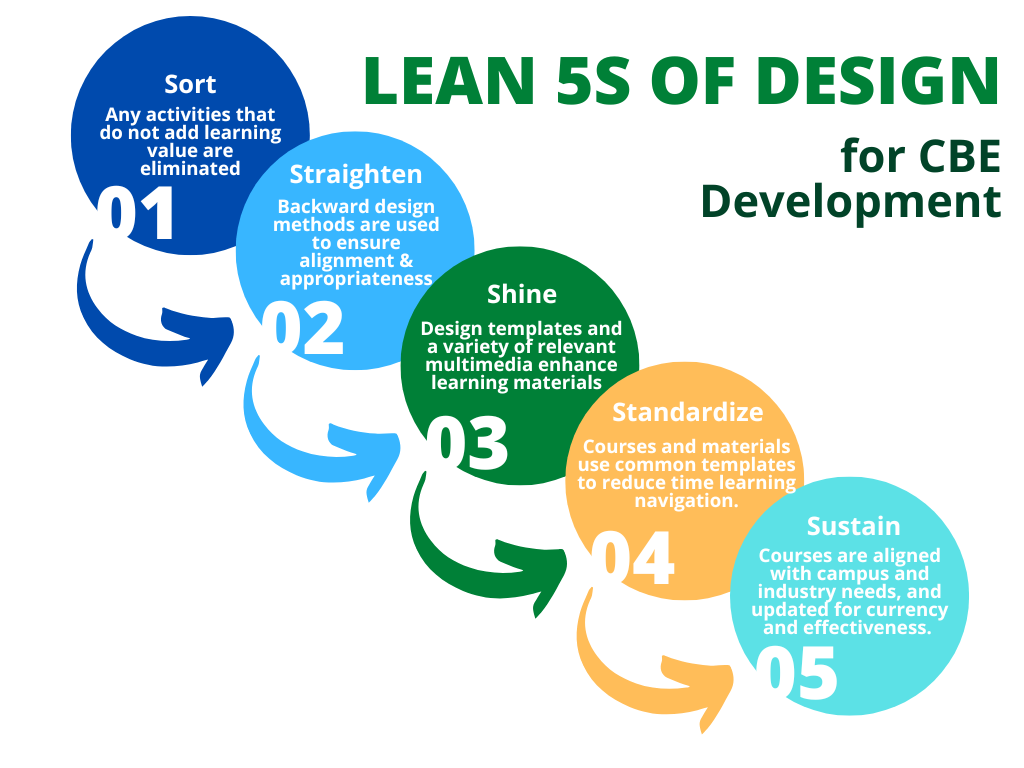
What is Lean Teaching, in YourPace?
LEAN thinking, when applied in a competency-based educational context focuses on the value that the skills (competencies and outcomes within CBE courses) add to students’ current or future workforce needs–as well as our ability as educators, to make that connection explicit.
In industry, LEAN practices focus on continuous improvement–which we support in students through the creation of authentic and relevant assessment (practice) activities, and programmatically through rigorous quality assurance and regularly-scheduled course and competency updates. In industry, LEAN principles also value respect for people–in our case, students, we do not seek to use students’ precious time with redundant tasks that do not directly contribute to the learning process and recognize our students as active co-creators of knowledge.
How is the value of higher education improved by utilizing a LEAN model of CBE?
According to Emiliani (2015), Lean processes seek to improve the quality of teaching (focusing on the reduction in errors, or ‘things that do not work’), by improving the course flow (eliminating extraneous content bloat, design inconsistency, and barriers), and by improving the quality of learning (knowledge and skill retention and successful skills application).
How does LEAN teaching connect with UMPI initiatives to support student-centered and experiential teaching and learning?
Lean approaches support UMPI’s Academic Commitment to student-centered learning by anchoring in skills-based, measurable learning outcomes and prioritizing consistent design as a student-centered practice. This approach also values students as knowledge co-creators, and through the mastery-development structure, allows students to try, apply, adjust, and revise as needed, and places a premium on reflection and connection to how these skills (i.e. outcomes/competencies) transfer across career and after-academia needs.
Does LEAN design mean that CBE courses are cookie-cutter?
No, Lean design takes the cognitive task of learning the individual instructor design flow out of the equation, so that all of the course learning takes place on learning the course content, which will vary considerably, depending on the discipline, level, outcomes, and purpose of the course!
Does designing and teaching LEAN mean watering down content to make it easier?
Contrary to popular belief, the Lean course design does not mean making content easier or watered down, or only giving students limited access to essential content–in fact, students should need access to essential course content in order to effectively apply the course/discipline-specific skills–this is what makes content essential. This is why aligning with the course and program Outcomes (i.e. the competencies of CBE) are so important. Content is important and should help students develop competencies and skills–but there should not be content for content’s sake. Lean design calls on highly qualified subject-matter development faculty to avoid curricular bloat by focusing content on what aligns and engages.